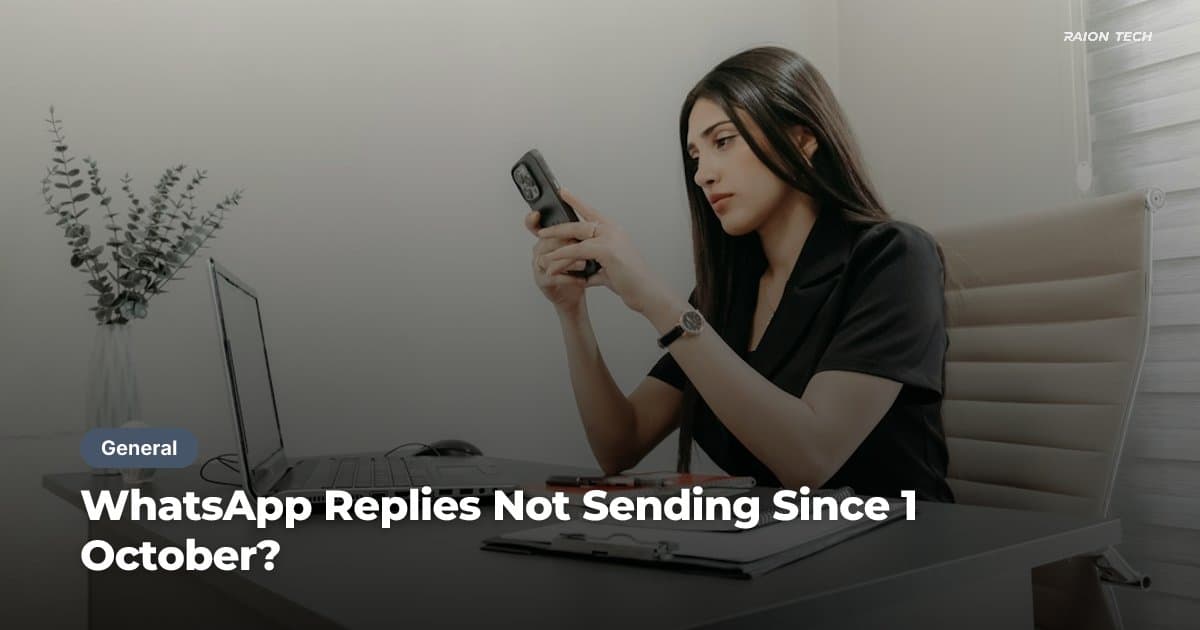
WhatsApp Replies Not Sending Since 1 October?
Meta stops delivering WhatsApp service replies from 1 October 2026 for accounts with no payment method on file. Here is the 3-minute fix and the real bill.

If your WhatsApp replies stopped arriving on 1 October 2026, check one thing before anything else: whether your WhatsApp Business account has a payment method on file. From that date Meta bills service messages, and it stops delivering them for any account that had no card registered by 30 September. Customers keep writing. Your replies go out from the dashboard and never land.
Nothing tells the customer this happened. Nothing tells you either, unless you know where to look. This post covers the cause, the three-minute fix, what the bill actually looks like for a Malaysian business, and the other 1 October changes to rule out if the card is already there.
From 1 October 2026 Meta charges for WhatsApp service messages, the ordinary replies sent inside the 24-hour customer window, and stops delivering them for any Business Platform account with no payment method on file by 30 September. The fix is adding a card in Meta Billing Hub, which takes about three minutes. The bill is smaller than the fear suggests: every business phone number gets 1,000 free service messages a month, and above that Malaysia is billed at roughly RM0.06 per reply, so most one-number SMEs never pay anything.
Why did my WhatsApp replies stop sending on 1 October?
The most likely cause is a missing payment method. Meta's notice to solution providers is explicit: for any provider or directly integrated business without a payment method on file by 30 September 2026, Meta will stop delivering service messages from the moment they become chargeable on 1 October (360dialog, Service Message Charging Starts October 1, 2026).
A service message is any free-form reply your team or your chatbot sends inside the 24-hour window that opens when a customer messages you. "Yes, we are open Saturday." "The unit is RM1,800 a month." "Your appointment is confirmed for 3pm." These were free since November 2024. From 1 October they are billed per message at the same rate as utility templates in the customer's country (Meta developer documentation, pricing updates for service and utility messages).
The consequence of a missing card is not a warning banner or a higher bill. It is a delivery stop. One provider's plain description of the failure: customers keep writing, your replies stop arriving (Invent, Meta's WhatsApp Payment Method Deadline Explained). Because the stop is silent on the customer's side, the first signal most businesses get is a phone call asking why nobody answered.
Only accounts on the WhatsApp Business Platform, meaning the API, are affected. That includes any number connected to a CRM, an AI assistant, a booking tool, or a broadcast platform. If your team replies from the free WhatsApp Business app on a phone, nothing changes for you and there is no card to add.
Who holds the payment method: you or your provider?
Before touching Billing Hub, answer one question: which entity is billed for your number. This is the step most explainers skip, and it decides whether the fix is yours to do at all.
There are two common setups. In the first, your provider pays Meta on your behalf and invoices you, so the provider holds the payment method and your account is covered. In the second, your business connected the number through its own Meta Business portfolio and Meta bills you directly, so the card must be on your portfolio. 360dialog lists "confirm which entity holds the payment method" as the first action for every business, ahead of registering the card itself.
If you are on a platform and not sure, send your provider one message: "Who holds the Meta payment method for my WhatsApp number, you or us?" A provider who bills you monthly for message usage almost certainly holds it. A provider who told you at setup to "add a card in Meta" almost certainly does not.
How do I add a payment method to WhatsApp Business?
Adding a card takes about three minutes in Meta Business Suite. The steps below follow the Billing Hub path documented by Invent, with one verification step added at the end so you can confirm delivery is restored.
How to Add a Payment Method to Your WhatsApp Business Account
Do this on the day you notice the problem, not at month end. Every hour without delivery is an hour of enquiries that look ignored, and a lead who asked a price on Wednesday and heard nothing has usually asked two other businesses by Thursday.
How much will WhatsApp service messages cost from 1 October?
For most one-number SMEs in Malaysia, nothing. Every business phone number receives 1,000 free service messages a month, billing starts at the 1,001st, the allowance resets monthly and does not roll over (SendPulse, WhatsApp Service Message Pricing Changes in October 2026). Above the free tier, the Malaysia rate is USD 0.0140 per service message, about RM0.06 at current exchange rates, with no volume discount (360dialog rate table, same source as above).
The useful way to read that number is by chats per day. Assume three replies per conversation, which is typical for an enquiry that gets answered, asked a follow-up, and confirmed. Over a 30-day month:
| Chats per day (one number) | Replies per month | Billable replies | Monthly cost (RM) |
|---|---|---|---|
| 10 chats | 900 | 0 | RM0 |
| 30 chats | 2,700 | 1,700 | about RM100 |
| 50 chats | 4,500 | 3,500 | about RM210 |
| 100 chats | 9,000 | 8,000 | about RM480 |
A two-agent property agency in Cheras handling 10 to 15 enquiries a day stays inside the free tier most months. A dental clinic in Penang with one number and 30 conversations a day pays roughly the cost of a lunch for two. The businesses that feel this are the ones running 50 or more chats a day through a single number, and even they are paying less than one part-time salary. The detailed RM breakdown by business type, including what the 24-hour and 72-hour windows mean for the count, is in our earlier post on what WhatsApp service messages will cost from October 2026.
Here is the claim this post is making: the 1 October change is not a pricing problem for most Malaysian SMEs. It is a switch-off problem. The vendor posts about this date are almost all cost calculators, and a cost calculator tells a 10-chat-a-day business that its bill is zero, which is true and useless. The thing that will actually hurt that business is three days of undelivered replies because nobody added a card.
What else stops WhatsApp messages on 1 October?
If the card is on file and the account shows Active, the payment method is not your problem. Three other changes land on the same date, and each one looks different from the outside.
Utility templates inside the 24-hour window are now billed. Since July 2025, a utility template sent while a customer window was open was free. From 1 October it is charged at the utility rate like any other template (Meta developer documentation, same source as above). This does not stop delivery. It shows up as a higher bill for businesses that send order confirmations or appointment reminders as templates into open conversations.
Marketing messages fail for specific customers, not everyone. If only marketing templates are failing, and only to some numbers, that is Meta's per-user marketing cap, error 131049, not the payment method. The pattern and the fix are covered in why your WhatsApp marketing message was not delivered.
Messaging limits shrink with a falling quality rating. If replies to existing chats deliver but new outbound conversations are capped, look at the quality rating and tier, explained in how WhatsApp quality rating and messaging limits work. And if nothing sends at all and the number shows a restriction notice, that is a ban, which has its own recovery path in what to do when your WhatsApp Business number is banned.
The quickest way to tell these apart is to ask what fails. Payment method: every service reply, to every customer. Marketing cap: some marketing templates, to some customers. Quality tier: new conversations, not existing ones. Ban: everything, with a notice.
Frequently Asked Questions
Which WhatsApp conversations are still free to answer?
Two lanes stay free, and knowing which chat sits in which lane is the only real cost control left. The first is the free tier itself: the first 1,000 service messages per number each month cost nothing. The second is the 72-hour entry point window, which opens when a customer starts a conversation from a Click-to-WhatsApp ad or a Facebook Page call-to-action button, and stays exempt from the new charges (360dialog, same source as above).
That second lane matters more than it sounds. From what we have seen inside property agency inboxes, the flood is buyers asking price, location and layout plan, and every one of those answers is a service message. An agency whose enquiries arrive from Click-to-WhatsApp ads answers all of that inside a free 72-hour window. The same agency taking enquiries from a phone number printed on a banner pays after reply 1,000. Same conversation, same agent, different bill, decided entirely by how the chat began.
This is why we tag every lead by source. In Raion HUB a conversation that came from a Click-to-WhatsApp ad carries that tag from the first message, so the team can see at a glance which chats are in the free window and which are counting against the tier. It does not change how anyone replies. It changes whether the owner is surprised by the invoice.
Should you move back to the WhatsApp app to avoid the charge?
No, and this is the obvious move that goes wrong. A dental clinic in Penang that hears "service messages are now billed" and moves its receptionist back to replying from a phone saves, in most months, RM0. What it loses is the shared inbox, the reply history when that receptionist is on leave, the auto-reply at 9pm, and the record of which enquiries were never answered. It trades an invoice it was never going to receive for a gap it cannot see.
The same logic applies to the panic reading of the 30 September deadline. If you missed it, you are not locked out. Adding a payment method after the date restores delivery. The cost of missing the deadline is measured in days of silence, not in penalties, and days of silence are exactly what an aircon service company in Shah Alam cannot afford in a hot October.
The bottom line
Replies that stopped on 1 October 2026 almost always mean a WhatsApp Business account with no payment method on file. Add a card in Meta Billing Hub, complete the tax section, confirm the account shows Active, and delivery resumes. The bill itself is the smaller worry: 1,000 free service messages per number each month, then about RM0.06 each in Malaysia, which keeps most one-number SMEs at zero. The real cost of this change is silence, not spend.