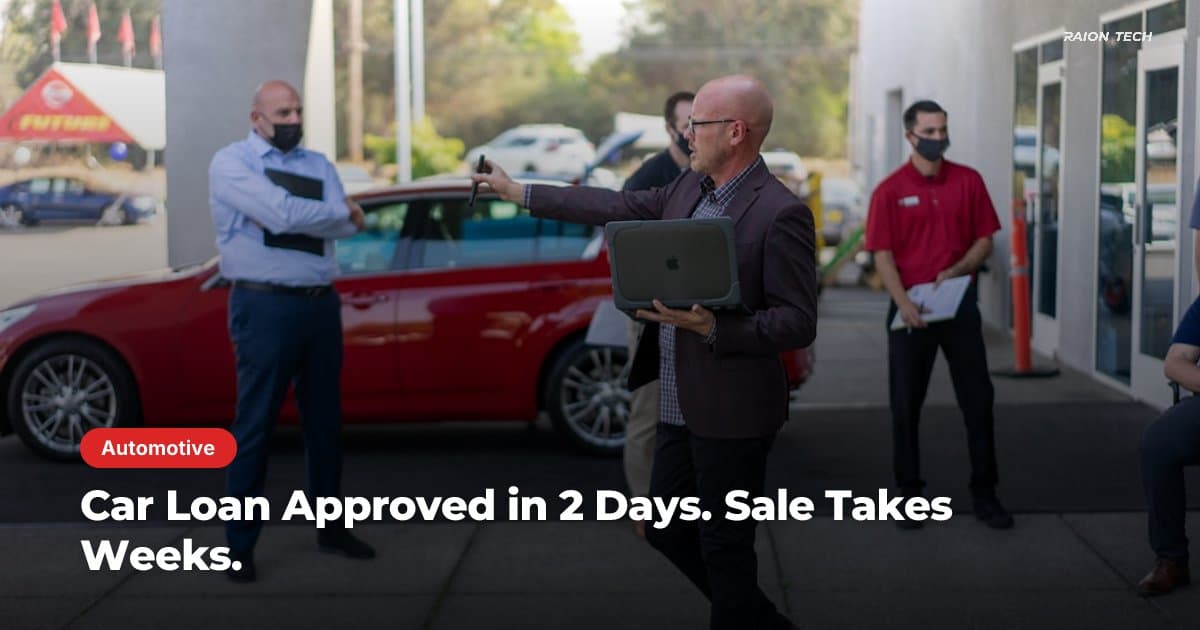
Car Loan Approved in 2 Days. Sale Takes Weeks.
Malaysian banks clear hire-purchase loans in days, but the sale still drags for weeks — because the real bottleneck sits inside the dealership, not the bank.

A buyer test-drives the car, likes the numbers, and signs the booking form. Everyone in the showroom treats that as the close. It isn't. What follows is a hire-purchase loan application that a Malaysian bank can clear in as little as five to six working days — documents in, interview, approval, agreement signed (kereta.info). Yet dealerships routinely watch that same file sit open for two, three, sometimes four weeks. The bank isn't the bottleneck. The sales advisor chasing a payslip through a WhatsApp thread is — and that's really a car loan document collection problem, not a lending one.
Hire-purchase loan approval in Malaysia is genuinely fast once a complete file reaches the bank — often five to six working days end to end. The weeks-long delays buyers and dealers actually experience happen before that, in car loan document collection: sales advisors manually chasing payslips, EPF statements, and bank statements through ordinary WhatsApp chats with no tracking, no checklist, and no reminder system. Fixing the loan process means fixing the document collection step that comes before it, not the bank's turnaround time.
Why does buying a car take weeks when banks approve loans in days?
Because the clock most people quote — documents submitted, bank interview, manager approval, signed agreement, each step taking one to two working days (kereta.info) — only starts once the file is complete. Getting there is the slow part, and it happens entirely on the dealership's side of the transaction.
A typical Malaysian hire-purchase application needs a copy of the buyer's IC, the latest three months of payslips, an EPF (KWSP) statement, three to six months of bank statements, and sometimes a letter confirming employment. None of that is hard to produce. What's hard is getting a buyer who already feels like they've "bought the car" to treat a payslip request with any urgency, while the sales advisor is juggling fifteen to twenty other open deals and has no system tracking which file is missing what.
The request usually lives inside the same WhatsApp thread used to negotiate price, discuss add-ons, and confirm delivery timing. By the time the buyer scrolls back to find "you also needed my EPF statement," it's buried under two weeks of unrelated messages. Nothing about an ordinary chat thread signals "this is an open task with a deadline" — so it doesn't get treated like one.
What does a stalled loan file actually cost a dealership?
More than a delayed delivery date. Every extra week a file sits incomplete is a week the buyer's decision stays reversible — and car buyers in Malaysia rarely stop shopping the moment they sign a booking form. A competing dealer's better trade-in offer, a family member's opinion, or simple loss of momentum can walk a "sure buyer" away from a deal that was, on paper, already closed.
There's a second cost that rarely shows up in any sales report: advisor attention. With fifteen-plus deals open at once, "who owes me what document" becomes a mental spreadsheet nobody maintains accurately. Advisors ask buyers for a payslip they already sent, which reads as disorganised at the exact moment trust matters most for an upsell on insurance or accessories. Meanwhile the file that's genuinely one bank statement away from submission gets no more priority than the one still waiting on a first response — because nothing distinguishes them except memory.
That gap is exactly why WhatsApp is already the right channel for this ask — buyers do see the message. The failure isn't reach. It's that the request disappears into an unstructured conversation instead of staying visible as an outstanding item until it's actually done.
| Manual WhatsApp chase | Structured document checklist | |
|---|---|---|
| Where the ask lives | Buried in the general deal chat | A standing checklist tied to that buyer's file |
| Who tracks what's missing | The advisor's memory | The system, per buyer, in real time |
| Follow-up on silence | Whenever the advisor remembers | Auto-chased on a set delay |
| Risk of asking twice | High — no record of what already came in | None — submitted items are logged |
| Visibility for a sales manager | None — lives in one advisor's phone | Every open file, every missing item |
How do you collect car loan documents without a WhatsApp scavenger hunt?
You stop treating it as a running conversation and start treating it as a checklist with a delivery mechanism. The channel doesn't need to change — WhatsApp's open rate already does the hard part — but the format of the request does.
How to Collect Car Loan Documents from Buyers in 5 Steps
This is the same document-tracking approach Raion HUB already runs for other paperwork-heavy trades: a structured checklist goes out, every submission logs against the buyer's record, and anything still missing gets auto-chased on a delay the dealership sets — so the advisor only sees the files that genuinely need a human decision. For a dealership specifically, that same platform also handles the test drive booking and lead routing that happens before the loan conversation even starts.
Frequently Asked Questions
What belongs on a hire-purchase document checklist?
Requirements shift slightly by bank and by whether the buyer is salaried, commission-based, or self-employed, but most Malaysian dealerships are chasing some combination of the following on nearly every file:
Naming all of it upfront, in one message, is what turns a vague "please send your documents" into something a buyer can actually clear in one sitting — instead of five separate WhatsApp pings spread across two weeks.
Does a structured checklist actually shorten time-to-delivery?
A four-advisor showroom in Klang ran document collection the ordinary way: each advisor messaged buyers individually, kept track in their own notes or memory, and chased whenever they happened to think of it. Files regularly sat "almost complete" for two to three weeks, not because buyers refused to cooperate, but because nobody had a clear, shared view of which single document was still missing on any given file.
After switching to a structured checklist with auto-chase on a three-day delay, most files moved from "booking form signed" to "submitted to the bank" in under ten days — not because buyers suddenly became faster at replying, but because no file could quietly go stale. The system, not an advisor's memory, was watching every open item, and a sales manager could see at a glance which deals were genuinely stuck versus which were one message away from done.
That's the same underlying pattern accounting firms hit chasing tax documents every season and insurance agents hit waiting on IC copies and nomination forms — momentum lost in the gap between "yes" and "done." It also connects directly to why trade-in enquiries go cold: the longer any part of a deal sits untracked, the more time a buyer has to reconsider, shop around, or simply lose interest.
The bottom line
The bank was never the slow part of a Malaysian car loan — a complete file clears in about a week. What actually stretches a sale into a month is the dealership chasing payslips and EPF statements through an ordinary WhatsApp thread with no checklist, no tracking, and no reminder beyond whatever the advisor happens to remember. Naming every required document upfront, auto-chasing what's outstanding, and routing every upload straight into the buyer's file turns weeks of quiet drift into a status any sales manager can check at a glance.