School Admissions: The Tour Isn't the Close
Most schools lose families in the two weeks after the campus tour, not before it. Here is the admissions follow-up that turns toured families into applications.

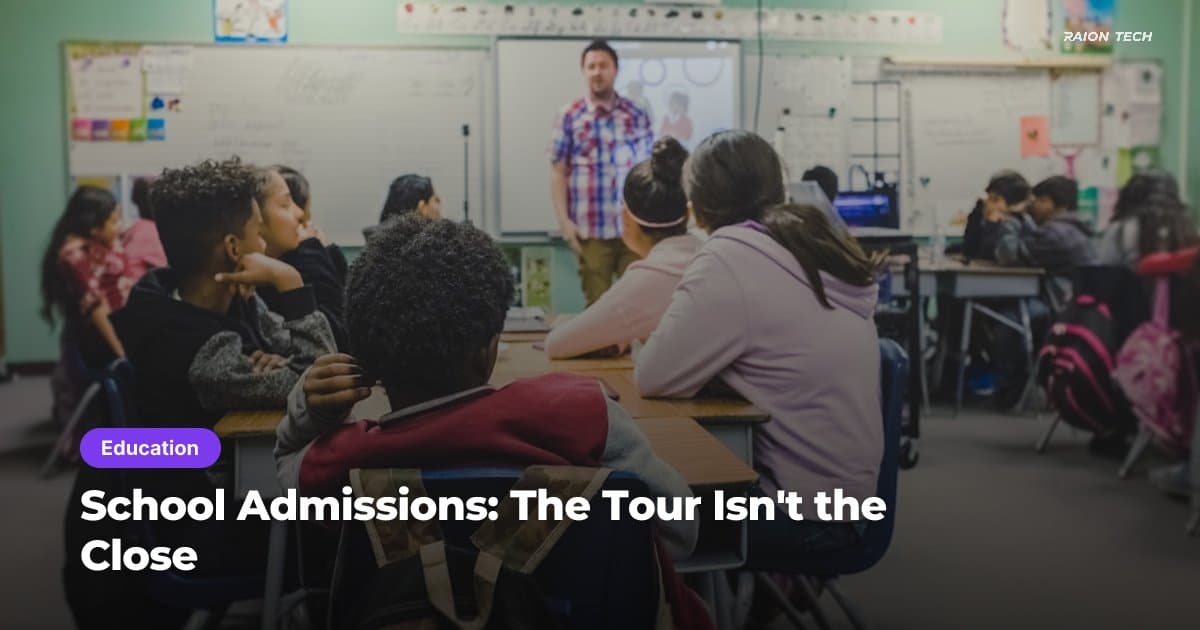
A family tours your campus on a Saturday morning. The head of primary walks them through the science lab. The child likes the pool. The parents say "we will discuss and get back to you." Then nothing. Three weeks later you learn they enrolled down the road.
Here is the claim this post is built on: the campus tour is not where school admissions are won. The two weeks after it are. Most admissions teams pour their effort into a better tour and leave the school admissions follow-up to whoever remembers. That is the gap where toured families quietly become someone else's students.
Families do not decide during the tour. They decide afterwards, while comparing two or three schools, and the school that sends a named next step the same evening usually wins. A structured school admissions follow-up means a same-day summary with the fee schedule attached, an application checklist the family can finish in one sitting, and a scheduled chase for the one document that always goes missing. Do that and the application arrives before the family's next tour, not after it.
Why do families tour a school and never apply?
Because the follow-up is slow, the application looks like homework, and nobody answered the fee question. A private-school marketing benchmark published in March 2026 puts a healthy tour-to-application rate at only 60 to 70 percent, and lists three reasons families tour but do not apply: the tour felt generic, the follow-up afterwards was slow or absent, and the application process looked intimidating (Cube Creative Design, 2026).
Read that number the other way. At a school doing everything right, three or four out of every ten families who took a Saturday morning to visit still never fill in the form. At a school where follow-up is "the officer will call when she has time", the leak is bigger, and it is invisible, because the family never says no. They just stop replying.
The same report notes that most parents make their decision during or immediately after the campus visit. That is exactly why the tour feels like the close. But "immediately after" is not "on the tour". It is the car ride home, the dinner-table conversation, and the comparison with the other school they toured last week. Your school is only in that conversation if something from you arrived in time to be part of it.
Where in the admissions funnel does the enquiry actually die?
It dies in the handover from "toured" to "applied", and in Malaysia the timing makes it worse. International school enrolment in the country grew 11 percent in the five years to July 2024, reaching 111,185 students, and around 67 percent of those students are Malaysian (ISC Research via Malay Mail, September 2024). Most of those local families are moving a child out of a government school at the start of the academic year, which means the January intake is the crowded one. For many Kuala Lumpur schools the peak application period is October to December (Regent International School, 2026).
Picture a two-person admissions office at a mid-sized international school in Mont Kiara in the last week of October. Twelve tours were booked this week through the website and a Facebook campaign. Each tour is 90 minutes. That is 18 hours of touring for one officer, plus the enquiries that came in while she was walking the campus. The follow-up for Monday's families is supposed to happen Tuesday. By Tuesday afternoon there are four new tours. Monday's families get a message on Friday, if at all. Meanwhile a school in Puchong, with a less impressive campus, sent its summary and checklist by 6pm on the day of the visit.
The same pattern shows up in a Penang preschool taking January registrations, a private secondary school in Johor Bahru courting families who commute to Singapore, and a bilingual school in Dubai. The busier the intake season, the longer the gap after the tour, and the gap is where the application goes to die.
The application stalls at a document the parent cannot produce
The obvious fix is "follow up faster", and it is right, but it is incomplete. Look at what the application actually asks for. A typical Malaysian international school wants the child's birth certificate, passport or identity documents, recent school reports, and health and vaccination records (Regent International School). Some also want a transfer letter or a confidential reference from the current school.
Half of that list is in a drawer at home. The other half is not. The previous school's report card, the transfer letter, and the teacher reference are produced by somebody else, on their timeline, and a parent who has not yet told the current school they are leaving will put that request off for as long as they can. So the application sits at 70 percent complete for three weeks, and from your side it looks exactly like a family who lost interest.
Before the family leaves, ask one thing: "Which of these documents would you need to request from the current school?" Whatever they name is the item your follow-up should chase, because it is the one that will stall the file. The parent will not volunteer this. They do not yet think of it as a problem.
This is why a follow-up that only says "just checking if you have any questions" gets no reply. The family has no questions. They have an unfinished checklist and a slightly awkward conversation waiting at the current school. The follow-up that moves them is the one that names the missing item and makes it smaller: "Most families get the report card as a PDF from the class teacher within two days. If you would like, I can send you the wording parents use to ask."
How do you follow up after a school tour so families actually apply?
Run the follow-up as a fixed sequence that fires from the tour itself, not from the officer's to-do list. The steps below assume nothing more than a shared calendar, a pipeline with named stages, and a way to send messages on a schedule. If you manage admissions in a CRM, each step maps to a stage change. If you run it by hand, put the timings in a spreadsheet and hold yourself to them.
How to Follow Up After a School Tour So Families Apply
Two rules make this sequence work. First, it pauses the moment the family replies, so nobody gets a Day 5 chase two hours after sending their documents. Second, every message names the next physical thing to do. Families do not need encouragement. They need to know which document is next.
Frequently Asked Questions
What does admissions follow-up look like when the system runs it?
The manual version above works for one officer handling a quiet term. It breaks in October, when tours and enquiries arrive faster than the follow-ups can be typed. At that point the sequence needs to run off the pipeline stage, not off a person's memory, and this is what a sales automation platform built for service businesses does for a school.
In Raion HUB for education providers, a family's record moves through stages you name yourself: Enquiry, Tour booked, Toured, Checklist sent, Documents complete, Offer, Deposit paid, Enrolled. Each stage change can trigger a message. The tour itself is booked against the admissions officer's Google Calendar, so the family picks a real slot and gets a reminder the day before. When the officer moves the record from Tour booked to Toured, the same-day summary and checklist go out. The checklist is a structured document request, so the system knows which items have arrived and chases only the missing ones on the delay you set. The follow-up sequence pauses when the parent replies and resumes if they go silent again.
AI labels do the sorting: year group, curriculum, intake month, and whether the family named a document they must request from the current school. Those labels decide which officer gets the record and which sequence runs. A January-intake Year 1 family and an August-intake IGCSE transfer get different messages without anyone writing them twice.
| Admissions step | Tour-first office | Follow-up-first office |
|---|---|---|
| Tour booking | Back-and-forth over three messages | Family picks a live calendar slot, reminder sent day before |
| After the tour | Officer follows up when the week allows | Summary, fees and checklist sent same day on stage change |
| Missing documents | Discovered when the officer opens the file | Tracked per item, chased by name on a set delay |
| Silent families | Forgotten until the next intake, if ever | Day 5, 10 and 14 messages run, then the honest close |
| Officer time | Spent typing reminders | Spent on the families who replied |
The point of the system is not to send more messages. It is to make sure the two-person office in Mont Kiara sends the same follow-up in the last week of October that it sends in a quiet week in May, because the family touring in October is comparing you against a school that did.
Twelve tours a week in the October to December peak. Follow-up happened when the admissions officer had time, and families who toured on Monday often heard nothing until Friday. Applications arrived with documents missing and sat for weeks.
Tours booked against the officer's calendar. Moving a record to Toured sends the summary, fee schedule and a tracked document checklist the same evening. Missing items are chased by name on day 5 and day 10, and the sequence pauses whenever the parent replies.
Fix the follow-up before you fix the tour
There is a reason this matters more than the campus. The tour is a fixed cost. The pool, the lab, the classrooms and the head of primary's walking route are the same for every family, and improving them takes a capital budget. The follow-up is the one part of admissions that a two-person office can change this week, and it is the part that decides which of the three schools a family toured gets the application.
The same discipline applies well beyond international schools. A tuition centre whose parents go quiet after one enquiry has the same gap between interest and action. A language school that has automated its trial class bookings has already solved the calendar half and can add the checklist half. And the document chase is not an education problem at all; an accounting firm that stopped chasing clients for documents by hand uses the exact same tracked checklist. For the full picture of how enquiries should move from first contact to a closed file, the lead management system guide covers stages, assignment and follow-up for any service business.
The bottom line
The campus tour is where a family decides to consider you. The two weeks after it are where they decide to apply, and they spend that time comparing you with the other schools they toured. A school admissions follow-up that lands the same evening, names the missing document, and runs on a fixed schedule wins that comparison more often than a better tour does. Build the follow-up before the October peak, and let the pipeline stage fire it, so the last week of the intake season gets the same follow-up as the first.