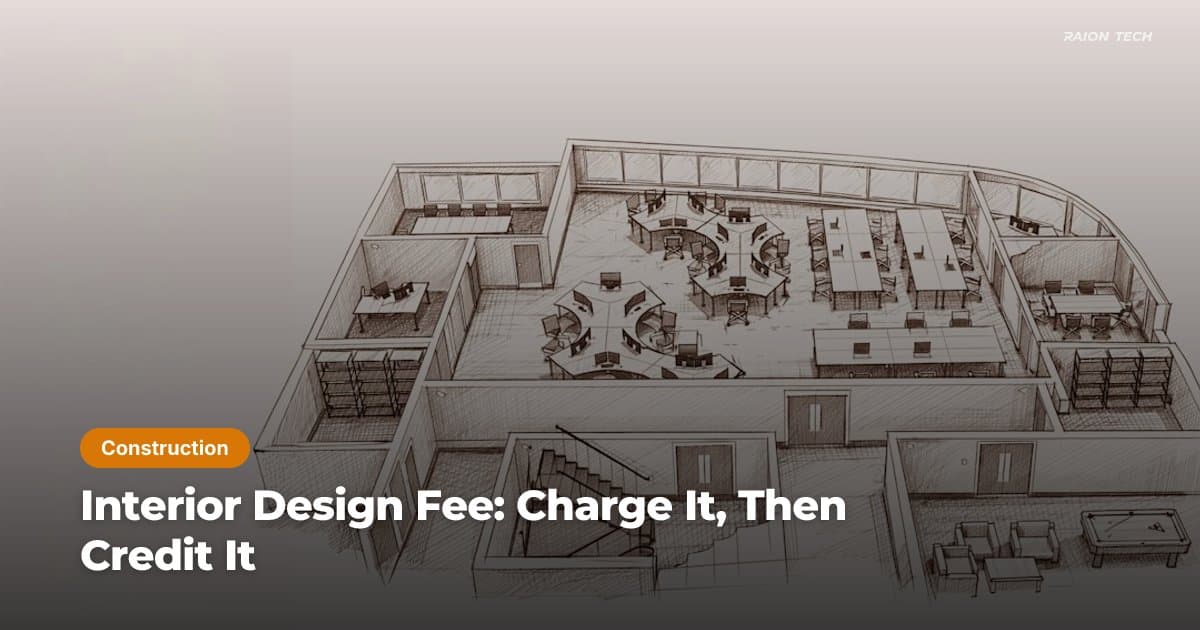
Interior Design Fee: Charge It, Then Credit It
Free 3D designs win enquiries from people collecting drawings to shop around. A design fee credited on signing filters them out and protects the work.

An interior design fee that is credited in full against the renovation contract when the client signs is a better sales tool than a free 3D design. Free 3D wins enquiries, but the dimensioned drawings your designer spent days on are exactly what a cheaper contractor needs to quote your design for less.
The position this post takes: stop giving away the drawings, keep giving away everything that builds trust (the fast reply, the site visit, the price range), and charge a modest design fee that comes off the contract when the client signs. Done right, the serious client hears "free if you build with us" and the shopper hears "not free". That difference is the whole point.
An interior design fee credited on signing does three jobs that free 3D cannot. It separates homeowners ready to build from homeowners collecting drawings, it pays your designer for the clients who walk, and it gives you a written agreement about who may build from your drawings. Keep the reply, the site visit and the price range free, charge for the renders and dimensioned drawings, say the credit before you say the price, and put an ownership clause in the agreement, because in Malaysia a paid commission can move copyright to the client unless you agree otherwise.
Why does a free 3D design attract the wrong clients?
Because a free design costs the homeowner nothing to ask for, so the request tells you nothing about whether they will build with you. The couple ready to sign next week and the couple collecting ideas for next year send the same WhatsApp: "can do free 3D?"
Most of them are also comparing. In a survey of more than 25,000 homeowners by the US home-improvement marketplace Modernize, nearly 60% said they compared three or more quotes before choosing a contractor (JLC Online, 2019). Malaysian homeowners have their own versions of the habit: quote marketplaces that send several firms from one request, Facebook renovation groups, and the cousin who knows a contractor.
Here is what your free design does inside that comparison. Without drawings, three firms quote three different kitchens and the homeowner cannot compare them. With your drawings in hand, every other contractor quotes your kitchen. The comparison becomes price only, and the firm that did no design work can always come in cheaper by exactly the cost of the design it did not do.
Picture a five-person design-and-build firm in Puchong. A couple with a 1,100 sq ft condo in Cyberjaya asks for free 3D. The designer spends most of a week on a layout, four renders and the carpentry drawings for the kitchen and wardrobes. The couple loves it, says they need to discuss, and goes quiet. Six weeks later the same L-shaped kitchen with the same fluted panels is being installed by somebody else. Nobody broke a contract, because there was no contract. This is a composite rather than one firm's story, but it is the outcome a free design leaves the door open to.
Notice which document did the damage. The render is what the couple fell in love with. The dimensioned carpentry drawings are what the other contractor quoted from. Most firms hand over both at once, for nothing.
What does a free design really cost your firm?
It costs your designer's time on every client who does not sign, and that cost lands on the clients who do. The market already puts a price on this work, which is why the giveaway is bigger than it feels.
Even standalone 3D has a clear market price. Recommend.my lists 3D interior packages from around RM1,200 for up to three rooms in a 1,200 sq ft condo, with larger jobs running to RM10,000 or more (Recommend.my, September 2024). As an illustration with round numbers: if your designer produces eight free designs a month and three of those clients sign, five designs a month go to people who never pay you. Valued at the bottom of that market price, that is RM6,000 of design work given away every month, before you count the site visits.
The contrarian part is that free design is not free for the client either. Qanvast notes that some designers charge the design fee separately, some give a discount, and some absorb it if the homeowner signs with the firm (Qanvast Singapore, 2017). Absorbed means it sits inside the contract price. So the homeowner who signs pays for their own design plus a share of the designs that walked, and your contract looks more expensive next to the contractor who did no design at all. Free design makes your best clients subsidise your worst ones.
How does a design fee credited on signing work?
A credited design fee is a fee the client pays before you start the 3D and detailed drawings, which you deduct in full from the renovation contract if they sign with you within an agreed window. For the client who builds with you, design costs nothing extra. For the client who walks, you were paid for the work.
| Question | Free 3D design | Credited design fee | Standalone design fee |
|---|---|---|---|
| Who pays for the design | Your signed clients, inside the contract price | The client upfront, refunded as credit if they sign | The client, whether or not they build with you |
| Who it attracts | Everyone, including people collecting drawings | Homeowners who intend to build soon | Homeowners who want design only |
| If the client walks | They leave with your drawings and you get nothing | You keep the fee, and the agreement says what they may do with the drawings | You keep the fee |
| How it sounds to a serious client | Generous, until they wonder where the cost went | Free if I build with them | An extra bill on top of the renovation |
Size the fee so a homeowner ready to build pays it without much thought and a homeowner collecting drawings hesitates. A sensible anchor is what an outside 3D package costs in your area, because it is easy to defend: "this is what the drawings cost anywhere; with us, it comes off your bill." It does not need to be your full design fee. Its main job is commitment, not profit.
Then decide what stays free. The rule of thumb: give away anything that builds trust, and hold back anything another contractor could quote from.
| Item | Free or in the fee | Why |
|---|---|---|
| Same-day reply with a price range | Free | Speed wins the enquiry; a range gives nothing away |
| Site visit and measurement | Free | It is where trust is built and scope is confirmed |
| Photos of similar past projects | Free | Shows taste and quality without a plan to copy |
| Full 3D renders | In the fee | This is the design the client falls in love with |
| Dimensioned layout and carpentry drawings | In the fee | This is what a cheaper contractor quotes from |
| Material and finish schedule | In the fee | It turns a look into a shopping list |
Who owns the 3D drawings if the client never signs?
Under Malaysia's Copyright Act 1987, drawings and plans are artistic works, and the person who draws them is the author. The catch is section 26(2): when a work is commissioned by someone who is not the author's employer, the copyright is deemed transferred to the person who commissioned it, unless the parties agree otherwise (Copyright Act 1987, Act 332). The Malaysian law firm Donovan & Ho advises parties to consider express clauses that exclude that transfer (Donovan & Ho, 2022).
Read that again from a renovation firm's side. The moment you start charging for design, a fee with no ownership clause may hand the client the right to build your drawings with anyone. Charging the fee is half the protection. The agreement is the other half.
Whether a free pitch design counts as "commissioned" is a question for your lawyer. In practice it rarely gets that far, because very few firms will take a homeowner to court over a kitchen layout. When a Malaysian designer went public on Facebook in 2022 alleging that a client had taken her roadshow booth design to a cheaper vendor, with what she called a 95% resemblance, the client denied using it and the matter ended in an undisclosed settlement, not a ruling (MustShareNews, 2022). That was a booth, not a home, but the lesson carries: the protection that works is commercial, set up before the drawing starts.
Three lines in a one-page design agreement do most of the work:
The buy-out line matters more than it looks. It turns the worst outcome, your design built by a competitor, into a sale you priced in advance.
This is general information about how the Copyright Act 1987 treats commissioned work. Have a lawyer word the ownership and buy-out clauses for your own design agreement.
How do you present the design fee without losing the serious client?
Lead with the credit, show what the fee buys, and keep everything before the drawings fast and free. A serious client is not afraid of a fee. They are afraid of paying twice, and the credit removes that fear in one sentence.
Speed still matters at the top. Everything in our post on why a same-day quote beats a better one in a week holds here: the first reply and the price range should go out the same day. The fee belongs later, at the moment the client asks for drawings.
How to Introduce a Credited Design Fee Without Losing Clients
Here are sample wordings for the WhatsApp reply when a client asks for 3D. They are our samples, not messages we have tracked, so adjust the scope and the figure to your own package.
EN:
We do. Our 3D and drawings come as a design package, and if you
renovate with us the full amount comes off your contract, so for you
it is free. For your unit the package is RM2,000: layout, 3D for the
living room, kitchen and master bedroom, and carpentry drawings with
measurements. Can I send you a sample from a similar condo we did?

BM:
Boleh. 3D dan lukisan kami datang dalam pakej reka bentuk, dan kalau
renovate dengan kami, jumlah penuh ditolak daripada kontrak. Untuk unit
ini pakejnya RM2,000: layout, 3D ruang tamu, dapur dan bilik utama,
serta lukisan kabinet dengan ukuran. Boleh saya hantar contoh dari
kondo yang serupa?
And for the client who says another firm offered free 3D:
That's fair to ask. Free 3D is still paid for, usually inside the
contract price or by the clients who don't sign. We'd rather show you
the design cost openly and take it off your bill. If you go with us,
you pay nothing extra for the design, and the drawings are ready for
your JMB application.
Expect fewer design requests once the fee is in place. That is the point. Judge the change by signed contracts, not by how many people asked for 3D.
Frequently Asked Questions
What changes in your pipeline once design is paid?
The first change is that the hardest yes gets smaller. A client who has paid for design has already made a financial commitment to your firm, so the move from design to signed contract is a continuation, not a fresh decision. It shrinks the gap we described in the deposit gap between yes and project start, because the first payment happened weeks earlier and was easier to make.
The second change is that you can finally measure the thing that matters. Split your leads into two groups, paid design and free consultation only, and compare how many of each sign. That is the same leak-by-stage thinking as our lead flow audit framework: find the stage where leads stop moving, then fix that stage instead of buying more enquiries.
This is where a sales system helps more than a spreadsheet. With Raion HUB set up for renovation firms, the AI chatbot answers "can do free 3D?" from the fee policy you upload, in the language the customer writes in, so the credit-first explanation goes out in English or BM at 11pm, worded from your own policy rather than improvised. It sends your sample drawing set into the chat as a file. As the conversation goes, it fills the lead's fields: property type, scope, budget range, keys date, and whether the design package was explained. Your team can take over any chat at any point. When the fee lands, someone moves the lead to a "Design fee paid" stage, and a filtered view of the pipeline shows how many of those signed against how many free-consult leads did.
Two honest limits. Raion HUB does not collect the design fee or issue the invoice; that stays with your own accounts process. And when a client sends a photo of their floor plan, it is saved in the chat for your designer to look at; the AI does not read the photo.
The bottom line
Free 3D design turns your best work into a free specification for the cheapest contractor on the homeowner's list. Charge a design fee that is credited in full when the client signs, keep the fast reply, site visit and price range free, and say the credit before you say the price. Put copyright, the credit window and a buy-out price in a one-page agreement before any drawing starts, then count signed contracts, not design requests.