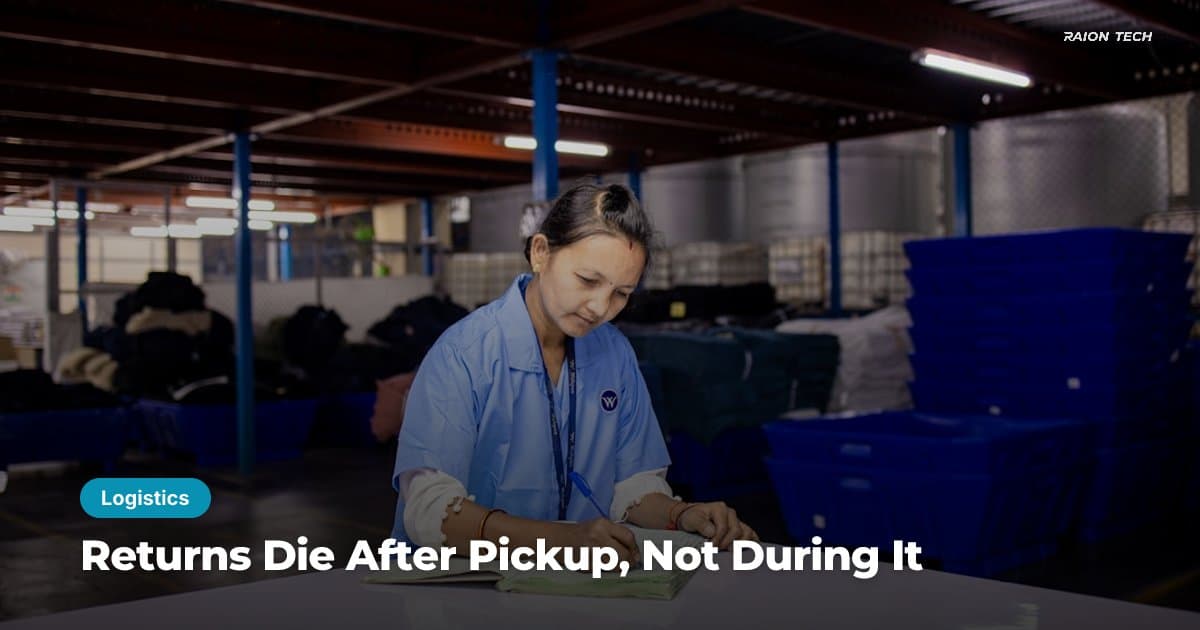
Returns Die After Pickup, Not During It
Ecommerce returns don't fail at the pickup — they fail in the WhatsApp handoff afterward, when nobody owns getting the customer to a refund.

A customer returns a jacket that didn't fit. The courier picks it up on schedule. Then it disappears into a warehouse, an internal group chat, and a finance queue — and the customer hears nothing for eleven days. The pickup worked perfectly. The return still failed, because nothing after the pickup had an owner.
Most reverse logistics advice focuses on pickup routing and courier costs, but the part that actually erodes customer trust happens after the item leaves the customer's hands: inspection, refund approval, and restock, handled across scattered chats with no single owner or deadline. Businesses that tag a return to a CRM field the moment it's requested — with a stage, an owner, and an automatic follow-up sequence — cut that dead zone from weeks to days, because the clock starts ticking the moment the field changes, not when someone remembers to check.
Why Do Ecommerce Returns Take So Long in Malaysia?
The honest answer: because pickup is the easy 10% and nobody designs a process for the other 90%. Once a courier collects the item, it typically passes through three separate teams — warehouse (inspection), operations (restock or write-off decision), and finance (refund approval) — and in most small fulfillment setups, those three teams talk to each other through whichever chat app is open, not through a system that tracks the handoff.
Globally, online returns now sit at roughly 19.3% of ecommerce sales, well above the 15.8% blended retail-return rate (WhiteBox, 2026). Malaysia's ecommerce market is growing 10–15% a year on top of that (Mordor Intelligence / market reports, 2026), which means the absolute number of returns any given seller has to process is climbing even if their return rate stays flat. More returns moving through the same ad hoc process means more of them stall.
Customer patience for that stall is short. 72% of shoppers expect a refund within 5 days of returning an item, and satisfaction drops 55% once a refund passes the 14-day mark (Ringly, 2026). A seller who takes two weeks isn't just annoying one customer — they're doing it at a rate that scales with their own growth.
The Return Doesn't Die at Pickup. It Dies in the Handoff.
Here's the part most returns guides skip: the pickup is the one step almost every fulfillment operation already does reliably, because a courier company is contractually on the hook for it. The handoff after pickup has no equivalent accountability. Nobody's KPI is "how fast did this specific return move from warehouse to finance."
Picture a mid-size fulfillment operator in Shah Alam handling returns for three online fashion brands. The driver confirms pickup in a driver WhatsApp group. The warehouse team logs inspection results in an internal Telegram channel, because it's faster than opening the CRM. Finance only sees a return once someone manually forwards a photo and says "can refund or not." Customer service — the one team the shopper is actually messaging — has zero visibility into any of it, so their honest answer to "where's my refund" is "let me check," three separate times, over ten days.
Nobody in that chain did anything wrong individually. The courier delivered. The warehouse inspected. Finance approved. The return still took eleven days because the work was correct and the ownership was invisible — the same failure mode as a lead that gets "worked" by six different agents without anyone being accountable for closing it. When a task can be everyone's job, it quietly becomes no one's job with a deadline.
The refund amount is the same whether it takes 2 days or 2 weeks. What changes is whether that customer buys again. Retailers processing refunds within 3 days report 12% higher repeat-purchase rates than those taking 14+ days (Claimlane / returns benchmarks, 2026) — the return itself is a retention event, not just an operational cost.
How Should a Return Move Through Your Team Without Getting Lost?
It should move the same way a sales lead moves through a pipeline: as a record with a stage, an assigned owner, and a timer — not as a message that has to be remembered. In Raion HUB, that means the return request becomes its own CRM entry the moment the customer messages for one, tagged automatically by AI Auto-Label with the return reason (wrong size, defective, changed mind), then routed through pipeline stages — Requested → Picked Up → Inspected → Refund Approved → Closed — with a follow-up sequence that pings the assigned team member if a stage sits untouched for more than a set number of hours.
The customer doesn't get silence between messages. They get an automatic WhatsApp update at each stage change — the same "out for delivery" logic used for delivery tracking updates, run in reverse. And because every field change is logged with a timestamp and author, "who dropped this" stops being a guessing game during the Friday ops meeting.
How to Build a Returns Workflow That Doesn't Lose Customers
What Happens When Nobody Owns the Return?
The customer starts asking three different people the same question, gets three different half-answers, and concludes the seller is disorganized — even if every individual step was handled correctly. That impression sticks longer than the return itself. A shopper who has a smooth return is more likely to buy again specifically because the seller proved they'd make it right; a shopper who has to chase a refund for two weeks assumes the next order will be just as much work to fix if something goes wrong.
| Manual / Group-Chat Tracking | CRM Stage-Triggered Workflow | |
|---|---|---|
| Where the return lives | Split across driver chat, warehouse Telegram, finance email | One CRM record with a visible stage |
| Who owns a stalled return | Whoever remembers to check | The team assigned to that specific stage |
| Customer updates | Only when they ask | Automatic on every stage change |
| Typical refund time | 7–14+ days | 3–5 days once the process is followed |
| Audit trail | None — relies on memory | Timestamped log of every field change |
Frequently Asked Questions
How Does This Compare to Just Hiring a Returns Coordinator?
Hiring a dedicated coordinator fixes the ownership problem for exactly as long as that person is available. The moment they're on leave, in another call, or handling a spike in volume, returns pile back up in the same scattered chats, because the process itself never became visible to anyone else. A stage-triggered CRM workflow doesn't replace a coordinator — it gives them (and whoever covers for them) a single place where every return's status is visible without needing tribal knowledge of "ask the warehouse guy."
This is the same logic that applies to lead handling: a good salesperson can compensate for a broken process, right up until they're unavailable and the process has nothing to fall back on. For a deeper look at what a visible, field-driven pipeline looks like for inbound orders (not just returns), see how Raion HUB structures a CRM pipeline around stages, owners, and automatic triggers rather than manual handoffs.
The Bottom Line
The pickup was never the weak link in reverse logistics — the unowned handoff between warehouse, finance, and the customer is. Turning a return into a CRM record with a stage, an assigned owner, and an automatic customer update closes that gap without adding headcount, and it turns a refund from a two-week chase into a tracked, time-boxed process the customer can actually see moving.
For the full picture of automating delivery communication in both directions — outbound orders and inbound returns — see the complete guide to WhatsApp for delivery and logistics. And if failed or delayed deliveries are part of what's driving your return volume in the first place, reducing failed deliveries with WhatsApp confirmation closes that loop from the other end.