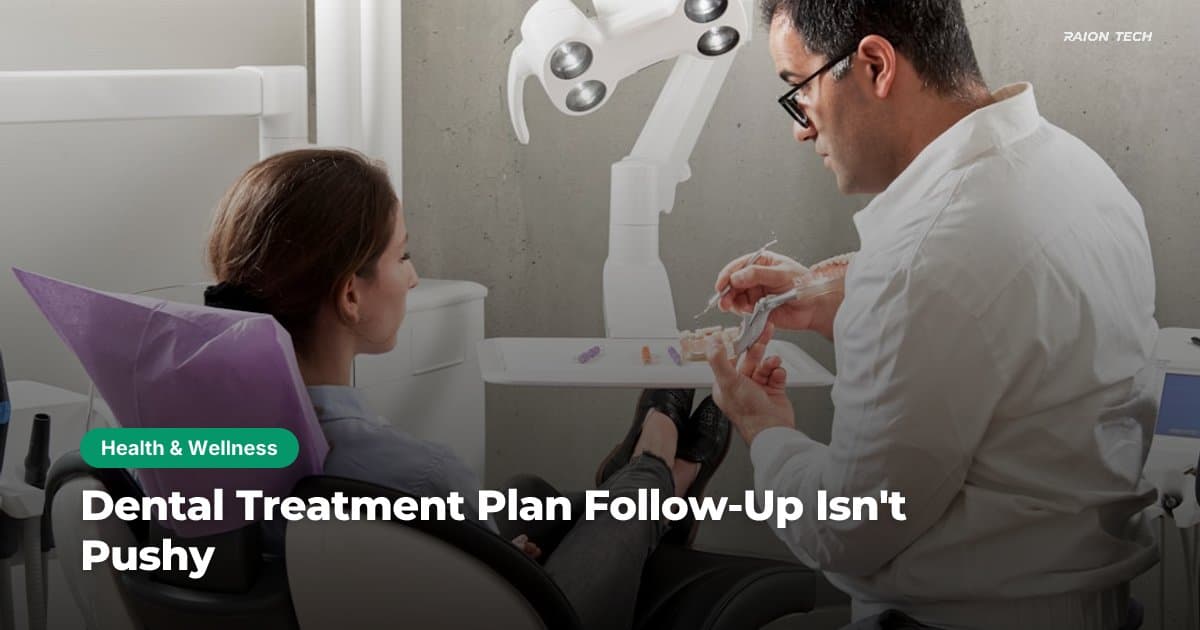
Dental Treatment Plan Follow-Up Isn't Pushy
Most treatment plans die at 'I'll think about it' because following up feels like selling. It isn't. Here is the WhatsApp sequence that reads as care.

The dentist explains the plan. Two crowns, or braces, or an implant. The patient nods, says "okay, I'll think about it", pays for the consultation, and walks out. Nobody messages them again. In most Malaysian clinics that is the end of the story, and the reason given at the front desk is always the same: "we don't want to look like we're selling." A dental treatment plan follow-up is not selling. It is the part of the treatment that happens after the patient leaves the chair, and skipping it is the single biggest leak in a clinic's revenue.
The average dental practice gets 45% of presented treatment plans scheduled; the top 10% get 75%, and the difference is rarely the dentistry. The clinics that close the gap follow up every unscheduled plan within 72 hours, from the dentist's name, with a clinical question rather than a price. On WhatsApp, in Malaysia, that follow-up takes ninety seconds to write and, run properly, nobody at the front desk has to feel awkward sending it.
Why does following up a treatment plan feel pushy?
Because the only follow-up most clinic staff have ever seen is a sales call. A receptionist in Kota Damansara who is asked to "chase the braces patient from Tuesday" pictures a telco agent reading from a script. So she doesn't call. Or she calls once, gets voicemail, and marks it done.
The mental model is wrong, and it costs real money. When a dentist diagnoses a cracked molar and recommends a crown, the crown is not a product. It is the treatment. A patient who does not book it is a patient with an untreated cracked molar. The follow-up message is the clinic checking whether the treatment it recommended is going to happen. That is care continuity. It is what a good GP does when a referral letter goes quiet.
The numbers say the gap is enormous. According to the 2026 Catalyst Index, the average dental practice sees 45% of presented treatment plans scheduled or completed, while the top 10% of practices reach 75% (Henry Schein One, 2026). Preventive and hygiene recommendations get accepted 85 to 95% of the time; elective work such as crowns, implants and cosmetic treatment sits at 50 to 65% in most general practices (Dentalbase).
Read that gradient carefully. Acceptance drops as the treatment gets bigger and more expensive. Those are precisely the plans nobody follows up, because a RM9,000 braces plan feels like a big ask and a RM150 scaling does not. The clinic goes quiet on exactly the patients who need the most help deciding.
What actually happens after "I'll think about it"
Nothing, usually. In the sales operations we have looked inside, the pattern repeats across industries: a lead gets a name attached to it and then no first message, and there are no consequences for the person whose name it was. Clinics are no different. The plan sits in the patient file. If the patient comes back for a scaling in eight months, somebody might mention it.
Meanwhile the patient is not weighing your plan against nothing. They are weighing it against a second opinion from a clinic in Bangsar, a cousin who says braces are cheaper in Johor, and a spouse who has to agree to the instalment. In Malaysia, braces run from roughly RM3,500 to RM25,000 depending on type and clinic (MalayMedical, 2026). At that ticket size, the decision usually involves a second person who was not in the room. The patient did not say no. They said "not yet, and not alone."
That is the un-obvious part. The follow-up is not a reminder for the patient. It is often material for the patient to forward to whoever is helping them decide. A message with the plan attached as a PDF and a plain-language instalment breakdown gets forwarded to a husband or a mother. A phone call does not.
How soon should a clinic follow up an unscheduled treatment plan?
Within 72 hours, and the first message should come from the dentist. The highest-converting first follow-up happens within 48 to 72 hours of the consultation, while the diagnosis is still fresh; a second touch lands at day 7 to 10 for the ones genuinely thinking it over, and a recovery message goes at day 30 for the ones who got distracted (Dentalbase, 2026).
Most American advice on this topic assumes the follow-up is a phone call, with a text or email after the voicemail. That is the wrong shape for Malaysia. A patient in Petaling Jaya does not answer unknown numbers and does not listen to voicemail. They read WhatsApp. The channel is settled; what matters is what the three messages say and who they appear to come from.
| Sales-style follow-up | Care-continuity follow-up | |
|---|---|---|
| Sender | "Bright Smile Dental" | "Dr. Lim, Bright Smile Dental" |
| First line | "Just checking if you want to proceed with the crown?" | "Did anything about the plan on Tuesday not make sense?" |
| What is attached | Nothing, or a promo | The plan PDF and the instalment breakdown |
| Day 10 message | "Still interested? We have a 10% offer this month." | "If the full plan is a lot at once, the crown on the cracked tooth is the part that should not wait." |
| When it stops | When staff forget | The moment the patient replies |
| How it reads | Chasing | Caring |
The second column is not softer for the sake of politeness. It converts better because it answers the three things a patient is actually stuck on: I did not fully understand it, I cannot afford all of it at once, and I need to show someone else.
What should a dental treatment plan follow-up message say?
Ask the question the patient did not ask in the chair. Never lead with the price, and never lead with a discount. A discount on healthcare reads as either desperation or as proof the original quote was padded. Neither helps.
5 Steps to Follow Up an Unscheduled Dental Treatment Plan on WhatsApp
"Did anything about the plan not make sense?" invites a patient to say "actually, I didn't understand why I need two crowns" without feeling like they are haggling. Nearly every stalled plan has an unasked question underneath it. This line surfaces it.
Frequently Asked Questions
Why does this fail when it is left to the front desk?
Because it depends on somebody remembering, on a Thursday, to message a patient from Tuesday, in a tone they were never trained in, while the phone is ringing. The task is not hard. It is easy to skip, and skipping it has no visible cost that day.
That is why the fix is structural, not motivational. The trigger is the stage change: the moment a plan is marked "presented", the day 3 message is already scheduled. The receptionist's job becomes editing a pre-written message with the patient's name and the treatment, not composing one from a blank screen. The dentist's job is answering the replies that need a dentist.
This is what a clinic CRM built on WhatsApp is actually for. Not another appointment book. A pipeline where "plan presented" is a stage, a stage change fires a sequence, the sequence pauses on reply, and the reply is routed by what it contains. If you are still deciding whether the clinic needs a CRM at all, the WhatsApp CRM guide for clinics covers what changes on day one. The same machinery that reminds patients about appointments, covered in the dental clinic appointment automation guide, runs the treatment plan follow-up with a different trigger.
One more thing the structure fixes: the plan that was presented eight months ago. A lapsed patient with an open plan on file is your warmest re-engagement list, warmer than any ad audience. Winning back lapsed patients starts with the people who already heard the diagnosis and never booked.
What this looks like at a two-chair clinic
Around 40 elective treatment plans presented a month (crowns, braces, implants). Roughly half never got booked, and nobody followed up because the receptionist felt it was 'like selling'.
Marking a plan 'presented' now schedules a day 3 WhatsApp message in the dentist's name with the plan PDF attached, a day 10 phased-option message, and a day 30 message with two open slots. Any reply pauses the sequence and routes clinical questions to the dentist and instalment questions to the front desk.
The clinic did not add a salesperson. It added a stage, three messages and a routing rule. That is the whole intervention, and it is the same shape whether the plan is a RM1,200 crown or a RM20,000 aligner course. Raion's health and wellness setup runs this on the official WhatsApp Business API, with the sequence, the file sending and the dentist routing already wired; the broader CRM automation guide for Malaysian SMEs covers how the same pipeline logic applies outside the clinic.
The bottom line
A dental treatment plan follow-up is care continuity, not a sales call, and the clinics that treat it that way schedule far more of what they diagnose. Message within 72 hours, from the dentist, with a clinical question and the plan attached, then phase before you ever discount, and stop the moment the patient replies. Make the stage change fire the sequence so it never depends on a receptionist finding the nerve on a busy Thursday.