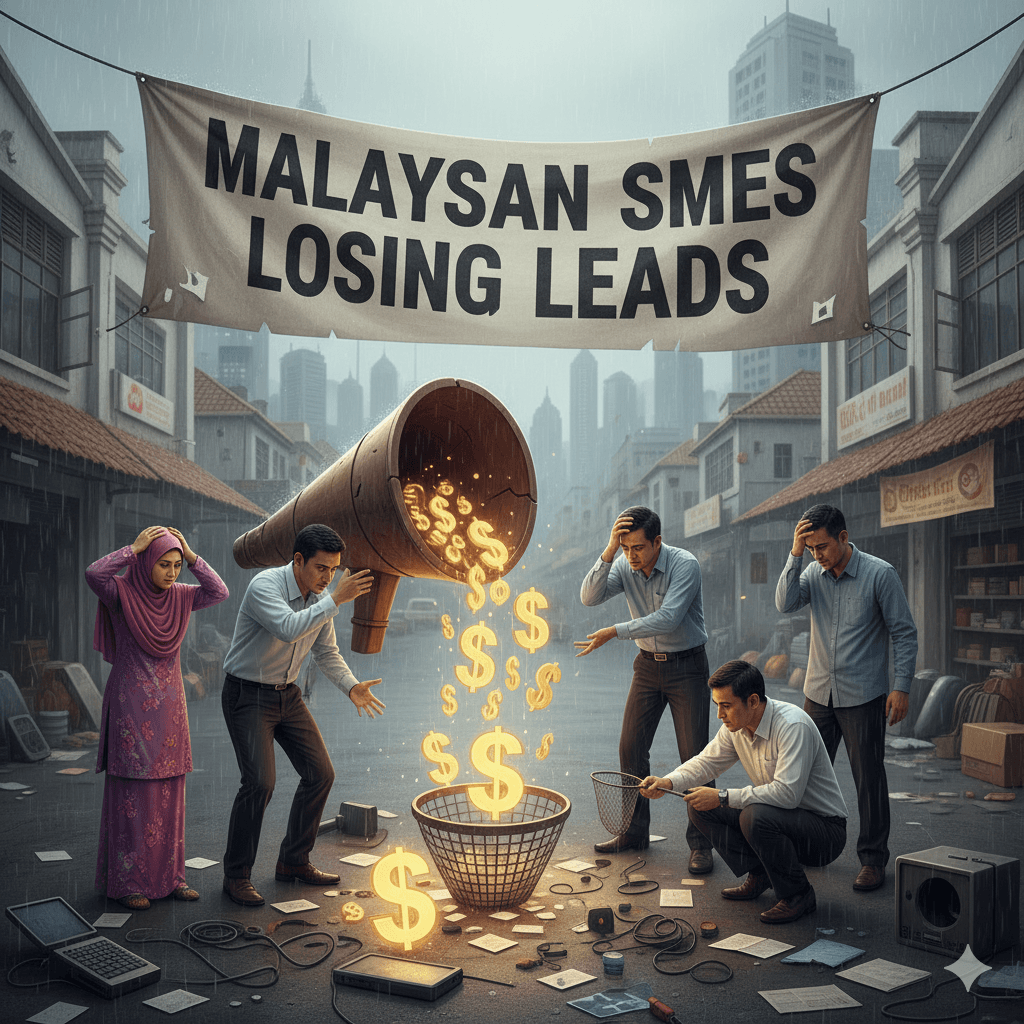
95% of Your Ad Leads Aren't Ready to Buy — Here's How to Still Convert Them
You're spending thousands on ads but only converting the 5% who are ready now. Here's a practical framework to capture the other 95% and turn them into customers over time.

Let's do some uncomfortable math.
Say you spend RM5,000 a month on Meta ads. You get 200 leads. Your team calls, texts, follows up. At the end of the month, you close maybe 6–10 deals.
That's a 3–5% conversion rate. And for most Malaysian SMEs, that's considered good.
But here's what nobody talks about: those other 190 leads aren't bad leads. They're just not ready yet.
- 95% of leads who enquire today are not ready to buy today — but most will buy from someone within 3–12 months
- The businesses converting at 10–15% aren't spending more on ads — they're following up systematically on the leads everyone else abandons
- A simple 3-message sequence over 7 days can recover 30–40% of leads you'd otherwise lose
- Automating the sequence is the only way to make it consistent — manual follow-up collapses under lead volume
- Every uncontacted lead is money you've already spent and will never recover unless you follow up
Where Your Ad Leads Actually Stand
The RM5,000 you're throwing away every month
Here's what happens in most businesses: a lead fills in a form. Your team replies. The lead says "I'll think about it" or doesn't reply at all. Your team moves on to the next fresh lead.
That first lead? Never contacted again.
Multiply that by 190 leads a month. Over a year, you've accumulated 2,280 people who showed interest in your business — and you've ghosted every single one.
If even 5% of those eventually converted, that's 114 extra deals you left on the table. Depending on your ticket size, that could be anywhere from RM50,000 to RM500,000 in lost revenue.
You're not just losing leads. You're paying to acquire them through ads, then abandoning them. Every uncontacted lead is money you've already spent and will never recover.
The framing matters here. Most business owners think of an unresponded lead as a neutral event — "they didn't buy, so nothing happened." But that's not accurate. You paid RM25 or RM50 in ad spend to get that lead to raise their hand. The moment you abandon them, that spend is gone. There's no neutral. There's only "I got value from this lead" or "I wasted the money I spent to acquire them."
This reframe changes how you think about the follow-up problem. It's not a nice-to-have. It's the difference between a profitable marketing channel and an expensive one.
Why leads don't buy immediately
Before we talk about solutions, let's understand why 95% of leads aren't ready. It's not because your ads are bad. It's because of how people actually make decisions.
Understanding these reasons is important because it changes how you design your follow-up. You're not trying to pressure someone into buying before they're ready. You're staying present and useful until they are ready. That distinction — pressure versus presence — is what separates follow-up that converts from follow-up that annoys.
The follow-up framework that recovers lost leads
The businesses that convert at 10-15% instead of 3-5% aren't spending more on ads. They're not hiring more salespeople. They're doing one thing differently: they follow up systematically.
Here's the framework:
The 4-Phase Lead Recovery Framework
Phase 1 is where most businesses already operate, at least partially. It's Phases 2 through 4 where the money is left on the table. The leads in those phases aren't lost — they're waiting. They're waiting for a competitor to reach out with something useful, or for you to remember them. Which one happens first determines who gets the sale.
Every follow-up message should give the prospect something useful — a checklist, a case study, an industry insight, a tool. If the only value you offer is "are you still interested?", you'll get ignored.
What this looks like in practice
Let's say you run a real estate agency in Petaling Jaya. A lead enquires about a condo listing on Monday. Your agent responds, the lead says "let me think about it."
Here's what happens without a system vs with one:
Without vs With a Follow-Up System
| Without System | With System | |
|---|---|---|
| Day 1 | Agent replies once | Agent replies + shares listing details |
| Day 3 | Nothing | Sends similar listings they might like |
| Day 7 | Nothing | Quick call to understand their timeline |
| Day 14 | Lead forgotten | Shares a buyer's guide for the area |
| Day 30 | Lead completely lost | New listings matching their criteria |
| Day 90 | — | Market update for their preferred area |
| Month 4 | — | Lead replies: 'Actually, I'm ready now' |
In month 4, we started closing deals from leads that came in during month 1. Leads we would have completely lost under the old system.
This pattern — closed deals arriving from leads that entered the pipeline months earlier — is one of the clearest signals that a follow-up system is working. It also reveals something about sales cycles that single-touch metrics hide: a business with a 3-month nurture window is not competing on the same timeline as one that abandons leads after Day 1. Once you build that pipeline depth, the month-over-month revenue becomes more predictable and less volatile.
The numbers behind systematic follow-up
Why Persistence Wins
The mismatch is staggering. Most deals require 5 or more follow-ups, but almost half of salespeople give up after the first attempt. In the Malaysian SME context, it's even worse — our research shows 67% of leads receive exactly one outbound message.
That gap between "what leads need" and "what businesses provide" is where your opportunity sits. Your competitor is making the same mistake. If you become the one business in your industry that actually follows up consistently and with something valuable, you win a disproportionate share of the leads that are just-not-yet-ready.
"But I don't have time to follow up with 200 leads"
You don't have to. That's the whole point.
The follow-up framework above works best when it's automated. Here's what that means in practice:
What an Automated Follow-Up System Does For You
Your team's job isn't to manually follow up with 200 leads. Their job is to focus on the ones who respond and let the system nurture the rest.
The practical question is: what does the automated content look like? It does not need to be elaborate. A follow-up library of 4–6 pieces of content can power an entire sequence. One checklist (useful for anyone in the buying journey). One case study (proof that your solution works). One market or industry update (genuinely new information). One comparison or guide. Rotate these across your lead cohorts and the content stays fresh without requiring weekly original writing.
The ROI of not giving up
Let's quantify this. Assume:
- Monthly ad spend: RM5,000
- Monthly leads: 200
- Current conversion: 5% (10 deals)
- Average deal value: RM3,000
Without follow-up system: 10 deals × RM3,000 = RM30,000/month
With follow-up system (recovering just 5% of the other 190):
- Original: 10 deals = RM30,000
- Recovered: 9.5 deals = RM28,500
- Total: RM58,500/month
That's nearly double your revenue without spending a single extra ringgit on ads. The only investment is a system that follows up for you.
A more conservative scenario still makes the case: if you recover 2% of abandoned leads instead of 5%, that's 3.8 additional deals per month — roughly RM11,400 in added revenue. Against a monthly automation cost that's typically a fraction of that, the ROI is clear.
And these numbers compound. As your database grows month over month, the pool of nurturable leads grows with it. By month 12, you might have 2,000 leads in various stages of nurture, with a small percentage converting each month from previous cohorts — entirely separate from your current ad spend.
Common objections (and why they're wrong)
How to get started this week
You don't need to build a 12-month nurturing machine on day one. Start small:
Your First Follow-Up Sequence (Set Up in 30 Minutes)
The 30-minute setup target is realistic. The checklist you send on Day 3 doesn't need to be a 20-page PDF. It can be a simple WhatsApp message: "Here's a quick checklist of the 5 things to look for when comparing [your category]." Three sentences in a list. That's content. That's value. That's a reason to stay connected.
Start there. Measure what happens. Then build on it.
Frequently Asked Questions
- You don't need more leads. You need to stop abandoning the ones you already have
- A simple follow-up system — even just 3 messages over 7 days — can recover 30-40% of leads you would otherwise lose
- The math is clear: recovering 5% of abandoned leads from a 200-lead monthly pipeline adds nearly RM28,500 in monthly revenue with no additional ad spend
- The businesses converting at 10–15% aren't smarter or better resourced — they just follow up where their competitors don't
- Start this week with 3 messages. Extend the sequence once you see what works.
Related reading
- 7 Sales Mistakes Malaysian SMEs Keep Making — A practical checklist to audit your entire sales process.
- From 2-Hour Response Time to 8 Minutes — How one Malaysian SME increased sales by 55% just by fixing their lead flow.