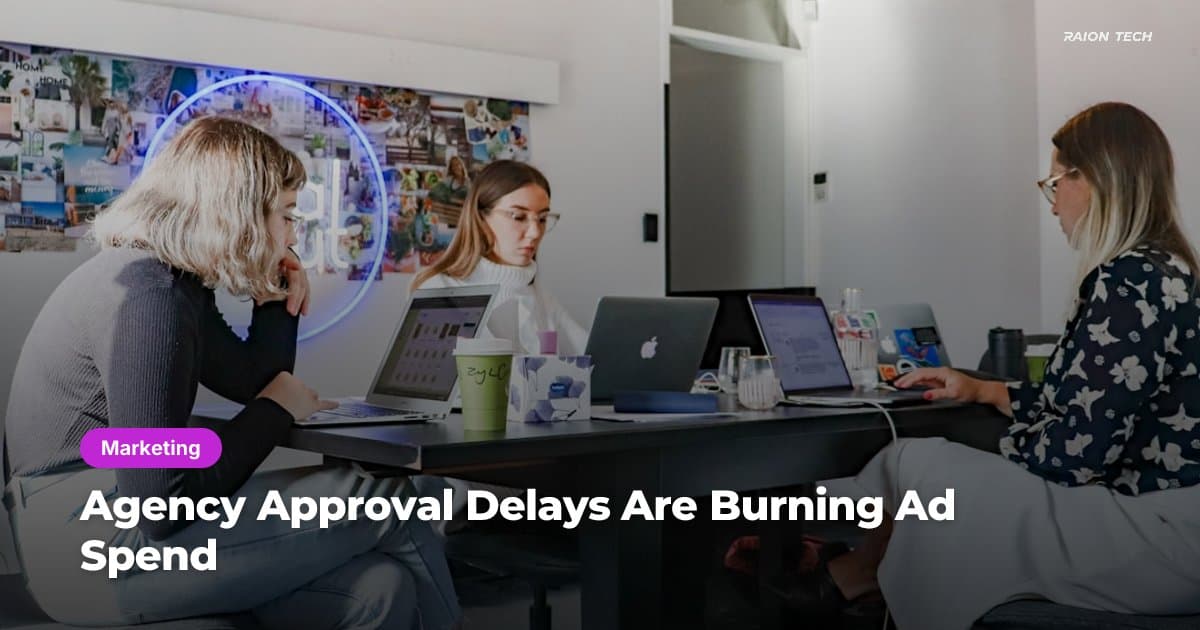
Agency Approval Delays Are Burning Ad Spend
Client approval delays cost marketing agencies flighted ad spend and blown launch windows. Here is the fix, and it is not more revision rounds.

Your creative is done. The media plan is locked. The only thing standing between your agency and a live campaign is one client, one WhatsApp message, and silence. Three days later, the flight window you booked is half gone and nobody chased it.
Most marketing agency client approval process breakdowns aren't a creative-quality problem — they're a chasing problem. Roughly half of marketers still run approvals through email or scattered chat threads with no automatic reminder, so sign-off sits untouched until someone remembers to follow up manually. Agencies that fix the chase, not the review, get campaigns live 3-5 days faster without adding a single revision round.
Why Do Client Approvals Take So Long?
Client approvals stall for one dull reason: nobody owns the reminder. A survey of marketing leaders found 42% of project delays came from internal stakeholders not giving feedback on time — not from the creative work itself. Separately, 48% of marketers still run their approval process through email, which means every "did you see this?" nudge is a manual act someone has to remember to do.
That's the part agencies get backwards. When a campaign misses its flight date, the account team assumes the client hated the creative and needs another round. Usually the client just didn't open the message. A performance marketing agency running Meta ads doesn't lose money because the ad was wrong — it loses money because the ad sat in a drafts folder for six days while the booked flight window ran down.
What Does a Stalled Approval Actually Cost?
It costs flighted media, not just time. A 3-person performance marketing agency in Petaling Jaya running Meta and TikTok ads for four clients — a home services company, two F&B outlets, and a small clinic — books media weeks in Google Sheets against a locked flight calendar. When a client approval slips from Tuesday to the following Monday, the agency doesn't get those six days of ad spend back. The campaign either launches late and burns through a compressed flight window at a worse cost-per-lead, or the whole slot gets pushed and reshuffled against three other clients' calendars.
Multiply that across a roster of eight or ten clients and the agency isn't managing creative anymore — it's managing an approval queue nobody can see. The account manager remembers to chase whoever complained loudest last week, and the quiet clients' campaigns just sit.
When one approval stage slips, every stage after it gets compressed. A campaign due to launch in 10 days with a 3-day review window has no slack left if approval doesn't land by day 4 — the launch date moves even though the creative was ready on time.
This is also why most agency churn isn't a results problem — clients don't fire agencies for a slow ad, they fire agencies who go quiet during the wait. Visibility into where an approval actually sits matters as much as the approval itself.
How Do You Fix a Slow Approval Process?
You don't fix it by adding another review round — that adds a stage, not urgency. You fix it by putting a deadline and an automatic reminder on every approval the moment it's sent, so the chase happens without anyone remembering to do it.
How to Fix Client Approval Delays at a Marketing Agency
This is the exact gap Raion HUB's follow-up sequences close for agencies — an approval request sent via WhatsApp pauses the sequence the moment the client replies, and resumes the reminder clock automatically if they go quiet. No account manager has to hold the chase in their head.
| Email approval thread | WhatsApp with auto-chase | |
|---|---|---|
| Where it gets read | Buried after 20+ unread emails | Same app the client already checks all day |
| Who remembers to follow up | The account manager, if they notice | An automatic reminder at 24h and 40h |
| Proof of sign-off | Scroll back through a thread | Timestamped approval logged to the CRM |
| What happens on silence | Nothing, until someone complains | Auto-escalates to a second contact |
Frequently Asked Questions
How Do You Roll This Out Without Disrupting Current Clients?
Start with the clients who cause the most rescheduling, not all of them at once. Pick the two or three accounts where campaigns most often slip past their flight date, move just their approval requests to a WhatsApp thread with a 24/48-hour reminder rule, and measure the turnaround time for two weeks before expanding.
What Changes When the Chase Is Automated?
The Petaling Jaya agency from earlier moved its four clients onto WhatsApp approval reminders with a fixed 24-hour first nudge and a 40-hour escalation to a second contact. Average approval turnaround dropped from just under 6 days to under 2. More important than the speed: the account managers stopped being the ones absorbing client frustration when a launch slipped, because the reminder timestamp showed exactly when the request went out and when it was chased — the delay was visible and no longer the agency's word against the client's.
That same visibility is what closes the loop on agency pipeline reporting too — a client who can see their approval history stops assuming the agency is sitting on their campaign. And it fixes the same trust gap that shows up after lead handoff between ad platform and sales team: the client stops blaming the agency for delays that were never the agency's fault in the first place.
The Bottom Line
A slow marketing agency client approval process rarely means the creative needs more work — it means nobody automated the reminder. Give every approval an SLA, send it where the client actually reads messages, and let a follow-up sequence chase the reply instead of an account manager's memory. Agencies that make this change don't add process — they remove the one manual step that was quietly burning flighted ad spend every week.