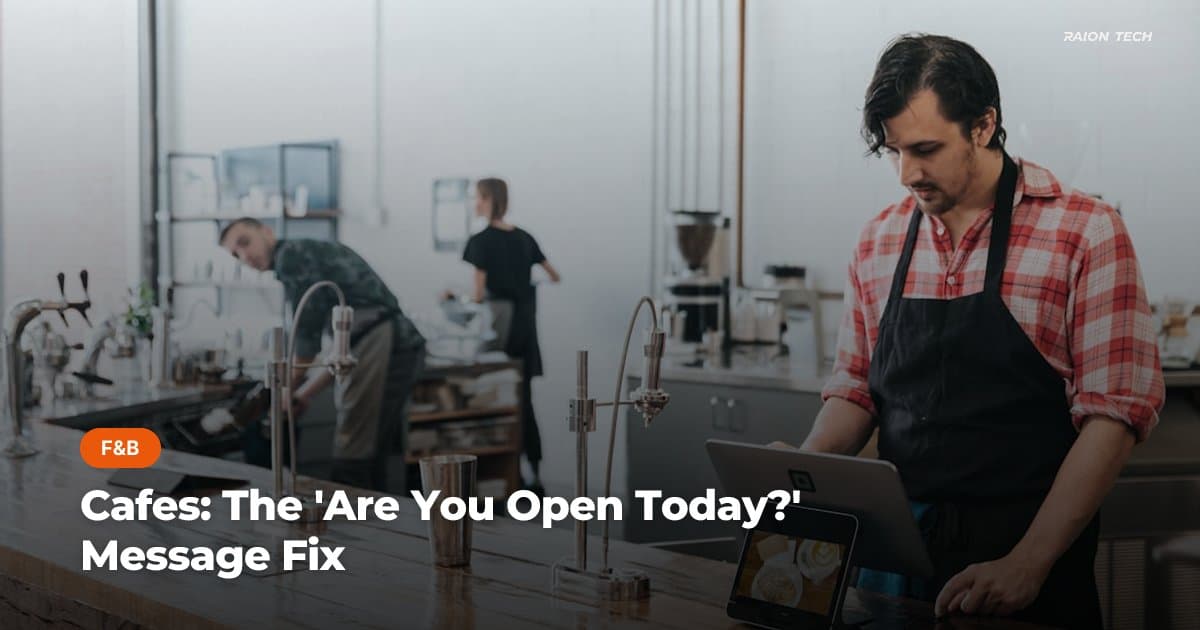
Cafes: The "Are You Open Today?" Message Fix
Every public holiday, Malaysian cafes lose tables to one unanswered question. Here is the two-line WhatsApp auto-reply that answers it while you serve.

The most expensive message a cafe receives is not a complaint. It is "hi, are you open today?" sent at 10:14am on a public holiday, read at 2:30pm when the rush dies down, and never answered because by then it does not matter. That customer went somewhere else, and so did the three friends they were bringing. This is not a marketing problem. It is a two-line auto-reply that most cafes never set up.
On a public holiday, a cafe's WhatsApp fills with one question: are you open, and until when. Nobody behind the counter can answer it during service, so the message dies unread and the table goes elsewhere. A WhatsApp auto-reply that states today's hours, the address and the next step, answers that question in seconds with zero staff time. It is the simplest automation in F&B and the one with the fastest payback.
Why does "are you open today?" cost cafes so much?
Because the question only arrives when the answer is uncertain, and the answer is uncertain on exactly the days you are busiest. Nobody messages a cafe on a normal Tuesday to ask if it is open. They message on Hari Raya, on the Agong's birthday, on the Monday after a Saturday holiday when half of KL is guessing which shops decided to close.
Malaysia has more of those days than most countries. Between national and state public holidays, a Selangor cafe faces around 16 to 18 gazetted holidays a year, plus the long-weekend replacement days that get announced at short notice. Each one produces a wave of the same message before you have finished setting up the machine.
The person asking is not browsing. They have decided they want coffee and have shortlisted you. All they need is a yes. If the yes does not come within a few minutes, the decision gets made for them by whichever cafe answered first, or by Google Maps showing a competitor's "Open now" in green.
What actually happens to that message during service?
Here is the honest sequence inside most cafes we have watched. The phone sits behind the counter. The barista sees the notification while steaming milk, reads the preview, thinks "I'll reply after this order", and then takes twelve more orders. At 2:30pm someone finally opens WhatsApp and finds nine unread chats: four asking about hours, two asking about parking, one asking if the place is halal, one asking to book a table for eight, and one asking if they can bring a cake.
Every one of those nine chats had a customer attached to it at 10am. By 2:30pm, none of them do. Replying late is not a partial win. It is the same as not replying, with the added cost of a customer who now knows you saw the message and ignored it.
The cruel part is that the cafes losing these tables are usually the good ones. A cafe with an empty floor has time to reply. A cafe with a queue does not. The busier you are, the more of these messages you drop, and the more free tables you leave for the competitor down the road who was quieter and answered.
How do you set up an auto-reply that actually answers the question?
The auto-reply most cafes set is the one that loses the customer anyway: "Thank you for messaging us! We will get back to you shortly." That message answers nothing. The customer still does not know if you are open, so they still go elsewhere.
A useful auto-reply is a fact sheet, not a greeting. It answers the top questions before they are asked and gives one clear next step.
How to Set Up a WhatsApp Auto-Reply for Cafe Opening Hours
Answering the opening-hours question is enough for most cafes. Do not try to take the whole order inside the auto-reply. The more the message tries to do, the less it does well, and the customer only needed one fact to walk in.
Frequently Asked Questions
What changes when the reply comes from an AI instead of a fixed message?
A fixed auto-reply covers the five standard questions. The sixth question is where it breaks: "are you open today until 4 or until 6?", "do you have a table for 12 at 1pm?", "is the kitchen still serving at 3:45?". A static message cannot read the question, so the customer gets the same fact sheet twice and gives up.
This is the point where an AI reply earns its place, and the setup is smaller than people expect. You upload one document with your hours, holiday hours, address, parking notes, dietary status and booking rules. The AI answers from that document in the customer's language, whether they wrote in English, Malay or Mandarin. When the question is a real booking request, it captures the pax and time and hands the chat to a human with the details already filled in. That is the same mechanism covered in restaurant reservations on WhatsApp, just applied to the question that comes before the booking.
What the AI does not need to do is take orders or process payments. A cafe with three staff on a holiday morning does not need a system that does everything. It needs the one question that arrives 40 times a day answered correctly every time. If you want the general setup for any business, the WhatsApp auto-reply setup guide walks through it step by step.
What does one public holiday look like with this in place?
A 40-seat cafe with three staff on holiday shifts. On the previous Hari Raya, 23 WhatsApp messages arrived before noon. Nine were answered, all after 2pm. The owner later counted at least six table requests among the unanswered ones.
Set a holiday-hours auto-reply with today's hours in the first line, a Maps link, the parking note and a single BOOK instruction. The Deepavali version was scheduled a week ahead.
The numbers are a composite of what this setup typically produces, but the pattern holds every time: the win is not more messages. It is the same messages finally getting the one-line answer they came for, at the moment the customer was ready to walk in. Once that habit sticks, the same list of regulars becomes the base for tracking your regulars and, later, a loyalty programme on WhatsApp.
The bottom line
"Are you open today?" is the cheapest question to answer and the most expensive one to ignore, because it only arrives on the days you cannot pick up the phone. Write an auto-reply that states today's hours in the first line, the address, the parking answer and one next step, and schedule the holiday version a week ahead. Start with the next public holiday on the calendar and count the tables that show up.